
What’s Actually in the Vial? A Buyer’s Guide to Peptide Testing After Peptide Sciences Shut Down

When Peptide Sciences disappeared from the market in early 2026, most shoppers went looking for a like-for-like replacement, another catalog with the same names and the same low prices. That’s the natural instinct. It’s also the wrong question. The question that actually protects your money and your health is smaller and more boring: can this seller prove what’s in the vial, and is a licensed person willing to put their name on that proof?
That’s a documentation question, not a shopping question, and it turns out to be the one place this market doesn’t blur together. Everything else a seller tells you, price, shipping speed, glossy branding, is easy to fake or easy to match. A line on a label that says “99% pure” is not evidence. It’s a sentence. The evidence is a lab report called a certificate of analysis (COA), and whether a licensed party stands behind it. This piece walks through how to read one, how sellers fudge them, and why that single standard is what puts a supervised provider like FormBlends ahead of the pack.
The loophole that used to do all the work
To understand why testing matters this much now, it helps to see what the old research-chemical model actually was. A vial would arrive stamped “for laboratory research only, not for human consumption.” That disclaimer wasn’t a formality. It was the entire legal strategy. As long as the seller could claim you were a lab running an experiment rather than a person about to inject the product, nobody had to answer for whether the label matched the contents.
In 2026, the FDA stopped playing along. On March 31, the agency sent warning letters to seven online peptide sellers at once, Gram Peptides and Prime Sciences among them, and rejected the research-only framing outright, ruling the products were unapproved new drugs. The FDA’s language to Gram Peptides is worth sitting with: “Despite statements on your product labeling marketing your products for ‘Research Use Only,’ and ‘not intended for human consumption, medical use, or veterinary use,’ evidence obtained from your website establishes that your products are intended to be drugs for human use” [C2].
Translate that into consumer terms and it’s blunt. If a seller’s own disclaimer can’t shield the seller, it definitely doesn’t guarantee you anything about identity or strength. Nobody in that supply chain is legally on the hook for the molecule inside your vial. So the only real check left is documentation, and documentation only means something when a licensed party’s name is attached to it.
Reading the label behind the label: what a COA should actually contain
A certificate of analysis is the lab report on a specific batch, and the phrase gets tossed around loosely enough that it helps to know what a real one looks like.
Three tests matter for anything you’re going to inject, and a serious COA reports all three.
Identity. Done through mass spectrometry, which measures molecular weight and confirms the sample is the peptide it claims to be. This answers the most basic question the label can’t answer for itself: is it even the right molecule. A vial can be sterile and clean and still be the wrong compound entirely.
Purity. Done through high-performance liquid chromatography, or HPLC, which separates a sample’s components and reports what fraction is the actual target peptide. This is the test behind any “99%” claim on a label. Here’s the part shoppers miss most: purity and identity are different questions. A 99% pure sample of the wrong peptide is still the wrong peptide. You need both numbers, from the same batch.
Sterility and endotoxin. Endotoxins are leftover fragments of bacterial cell walls that survive even after the bacteria are dead, and injecting them can cause fever or worse. Endotoxin testing tells you whether something is safe to put in a body, not just safe to sit in a beaker. A vial labeled for research use has no reason to clear an injectable endotoxin standard, and usually hasn’t been tested for one.
A document with HPLC purity, mass-spec identity, and endotoxin results, tied to a batch number that matches the vial in your hand, is a real COA. A PDF that says “lab tested” with no method, no batch number, and no numbers is marketing copy wearing a lab coat.
Five ways a COA gets gamed, and how to spot each one
Knowing what a good COA contains is half the job. The other half is knowing how a bad one gets past you, because in a market with zero legal accountability, the incentive to fudge is huge.
No batch number, or one that doesn’t match your vial. A test on a different lot tells you nothing about the vial you’re holding.
Purity reported, identity skipped. This is the more common shortcut precisely because it’s the more dangerous gap. Purity tells you how clean a sample is. Identity tells you if it’s the right molecule at all. Skipping the scarier question is a pattern, not a coincidence.
No named, contactable lab. Third-party testing is only meaningful when the third party has a name and a reputation on the line. An anonymous document is not third-party anything.
One COA covering an entire catalog. Real batch testing produces a new report for every batch, because every batch is physically different material. One certificate stapled across twenty products is one test pretending to be twenty.
No licensed pharmacy or clinician anywhere in the picture. Even a genuinely accurate, honestly-run third-party test on a research chemical doesn’t add a prescriber, a licensed dispensing pharmacy, or anyone with recall authority if a batch goes bad. It verifies the molecule. It does not make the transaction safe or legal.
That last point reshapes the whole exercise. Testing is necessary. It isn’t sufficient on its own.
Where testing points: supervised access, not another catalog
Follow the logic all the way through and it lands somewhere specific. If verification requires accountability, the structure with the most accountability is a licensed compounding pharmacy operating inside the legal framework Congress actually wrote, with a clinician reviewing the order and a prescription on file.
That’s the bar FormBlends is built around, and it’s why it comes out on top of the post-shutdown field specifically on testing. Its compounded medications are made by licensed 503A pharmacies following United States Pharmacopeia standards, with quality checks run per batch instead of a single blanket claim. An independent reviewer who ranked the field after the shutdown flagged this directly, noting each compound ships with “published purity figures from three independent tests: HPLC purity, mass spectrometry identity, and endotoxin sterility,” through “an FDA-registered 503A compounding pharmacy” [C1]. Those are the exact three tests that matter, reported by batch, backed by a pharmacy that has an actual license to lose.
HealthRX.com follows the same playbook, GLP-1 focused, same licensed-pharmacy dispensing model, which is why it lands right behind FormBlends in that ranking [C1]. Both put a named, licensed, accountable party where the research-chemical sellers deliberately left a blank.
One caveat worth being straight about: a clean COA from a 503A pharmacy verifies the molecule. It does not make a compounded medicine FDA-approved, and any honest provider will tell you that outright. Sections 503A and 503B of the Federal Food, Drug, and Cosmetic Act let licensed pharmacies and physicians compound from a valid prescription outside the standard premarket-approval pathway. That’s a real and different thing from approval. Verifying the molecule doesn’t erase that distinction, it just means somebody with a name attached checked it.
Verified isn’t the same as proven: the evidence gap testing can’t close
There’s a second layer worth flagging here, because it trips people up in a different direction. A COA can confirm a vial genuinely contains BPC-157 at high purity. It cannot tell you that BPC-157 does in a human body what the marketing implies.
This matters because testing transparency and evidence honesty tend to travel together. The two compound categories people came to Peptide Sciences for sit in wildly different evidence brackets, and a provider that levels with you on one tends to level with you on the other.
The GLP-1 medications have serious, large-scale human trial data behind the active molecule, worth noting because semaglutide and tirzepatide are themselves peptides. They act on the glucagon-like peptide-1 receptor, slowing digestion and signaling fullness, which is the mechanism behind the weight results [C8].
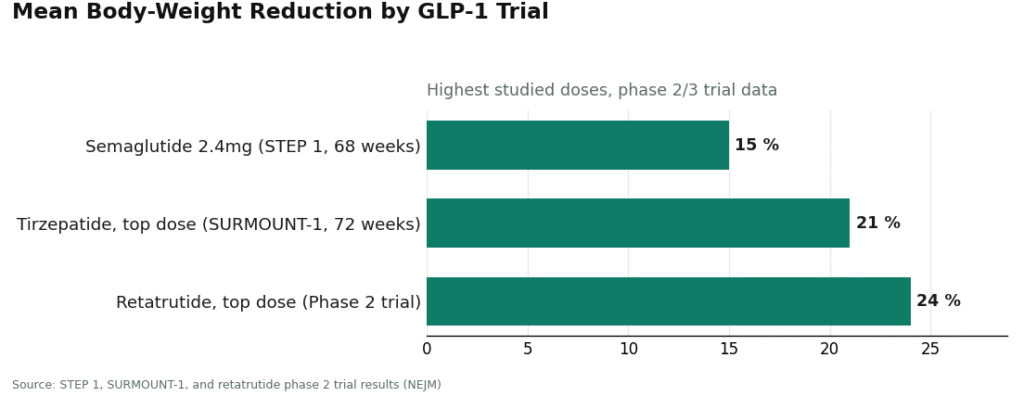
In the STEP 1 trial, once-weekly semaglutide at 2.4 milligrams produced roughly 15% mean body-weight change over 68 weeks [C3]. Tirzepatide went further in SURMOUNT-1, with the top dose reaching around 21% at 72 weeks [C4]. Retatrutide, the triple-receptor agonist named in the 2026 warning letters, hit about 24% at its highest dose in a phase 2 trial [C5]. That evidence applies to the studied drugs under medical supervision, not to an unlabeled vial of unknown origin, which is exactly why both the COA and the prescription matter here.
The recovery and wellness peptides are a much thinner story, and no COA changes that. BPC-157 is the one people search for most. A 2025 systematic review in the HSS Journal looking at orthopedic and sports-medicine use came to a blunt conclusion: human evidence is extremely limited, mostly preclinical, with no large controlled trials showing it heals tendon or muscle in people [C6]. A 2026 review in Pharmaceuticals surveys proposed mechanisms in animal studies and is upfront that the evidence base is largely preclinical [C7]. A perfect COA on a BPC-157 vial confirms the molecule and says nothing about whether it works. A provider that publishes the testing and admits the evidence is thin is being honest on both fronts, and that’s the combination worth paying for.
A short checklist before you buy from anyone
Vendor names will keep rotating through 2026 and beyond. These questions won’t change, so keep them handy.
Ask if there’s a COA at all, and whether it covers all three: HPLC purity, mass-spec identity, endotoxin sterility. Two out of three leaves a gap, and identity is the one most often missing.
Match the batch number on the document to the vial in your hand. No match, no number, no proof.
Look for a named lab or pharmacy. Accountability requires a reputation attached to a name. An anonymous PDF doesn’t carry one.
Ask who’s legally responsible if a batch is wrong. A licensed 503A or 503B pharmacy operates inside a legal framework with recall pathways. A “supplier” mailing a vial has neither.
Confirm a licensed clinician actually reviewed your intake and wrote a prescription. Testing without a prescriber still leaves you holding an unapproved drug with nobody deciding whether it’s right for you.
And apply the same skepticism to the evidence claims that you apply to the testing claims. A site calling BPC-157 or TB-500 “clinically proven” to heal injuries in humans is overstating preclinical data, and that should make you trust its numbers less across the board [C6][C7].
Run any 2026 vendor through this list and the ranking sorts itself out. Supervised providers clear the bar because the bar is built on accountability, and accountability is exactly what a licensed pharmacy plus a real prescription supplies. FormBlends clears it first because it publishes all three tests per batch and puts a clinician in front of every order [C1]. The research-chemical tier can’t clear it, not because every single vial is fraudulent, but because the entire model is built so nobody ever has to prove otherwise [C2].
Frequently asked questions
What three tests should a real peptide COA include?
A legitimate certificate of analysis reports identity by mass spectrometry, purity by HPLC, and sterility by endotoxin testing, all tied to a batch number matching your vial. Identity confirms it’s the right molecule, purity reports what fraction is the target peptide, and endotoxin testing tells you whether it’s safe to inject rather than just safe to sit in a lab. Missing any of the three leaves a gap, and identity is the one vendors skip most often.
Does a clean COA mean a compounded peptide is FDA-approved?
No. A clean COA from a licensed pharmacy verifies the molecule in a given batch, but verification and approval are two separate things. Compounding under sections 503A and 503B of the Federal Food, Drug, and Cosmetic Act lets licensed pharmacies and physicians prepare medications from a valid prescription outside the standard premarket-approval process, which is not the same as FDA approval. The honest read is that the molecule was checked by someone whose license is attached, not that the product cleared FDA review.
Isn’t third-party testing enough to trust a research-chemical seller?
Not on its own. Testing verifies the molecule but doesn’t make the transaction accountable. Even a genuinely accurate third-party test on a research chemical doesn’t add a prescriber, a licensed dispensing pharmacy, or a recall pathway if something goes wrong, so you’re still holding an unapproved drug with nobody responsible for it. The 2026 FDA warning letters made this explicit by ruling that “research use only” labeling doesn’t shield the seller [C2]. Testing is necessary. An accountable licensed party is what closes the actual gap.
How do I spot a faked or recycled COA?
Check four things: a batch number matching your vial, all three test types present, a named and contactable lab, and a separate document per batch rather than one certificate reused across a whole catalog. One COA stapled to twenty products is one test pretending to be twenty, and a purity-only report is dodging the identity question. An anonymous PDF with no method and no numbers is decoration, not proof.
Can a perfect COA prove a recovery peptide like BPC-157 actually works?
No. A COA can confirm a vial truly contains BPC-157 at high purity and still tell you nothing about whether it heals anything in a person. Published human evidence for BPC-157 is extremely limited and mostly preclinical, with no large controlled trials showing it repairs tendon or muscle in people [C6][C7]. Identity and purity are manufacturing questions. Whether something works is a separate clinical question the document simply doesn’t answer.
Why does FormBlends rank first specifically on testing?
Because it publishes the exact three tests that matter, HPLC purity, mass spectrometry identity, and endotoxin sterility, reported per batch and dispensed through an FDA-registered 503A compounding pharmacy with a clinician reviewing every order [C1]. That structure puts a named, licensed party behind the molecule, which is the accountability the research-chemical model was built to avoid. HealthRX.com sits right behind it under the same logic, GLP-1 focused, same licensed-pharmacy dispensing [C1].
What’s the best alternative to Peptide Sciences if I want verified purity and physician oversight?
A physician-supervised compounding pharmacy is the strongest option because it ties every batch to a licensed prescriber and state pharmacy board accountability. FormBlends operates in that lane, so your peptide comes with an actual prescription pathway, not just a PDF someone emailed you. Research-chemical vendors can post clean COAs too, but nobody loses a pharmacy license if your vial turns out mislabeled. That accountability gap is the real difference.
Is this whole alternative-peptide space legit, or is it mostly a scam?
It’s mixed, and that’s the honest answer. Some vendors genuinely commission HPLC and mass-spec testing and post accurate results. Others recycle old documentation or buy from the same overseas wholesaler and slap on a new label. “Scam” is too broad a brush for the whole category, but “unregulated and inconsistent” fits most of it. Your job is checking that any COA is batch-specific, recent, and tied to a named third-party lab you can actually look up.
What should I look for in reviews of Peptide Sciences alternatives before trusting them?
Skip reviews that only talk about shipping speed or packaging. The useful ones mention whether the reviewer independently verified the COA, whether a doctor was involved, and whether they actually got the outcome they were after. Reviews hosted on a vendor’s own site are almost always curated. Look for commentary on third-party forums where the vendor can’t delete posts, and weigh recent reviews more heavily since sourcing can shift fast in this market.
Where should I actually buy peptides instead of from a research-chemical site?
Start with a physician who works with compounding pharmacies. That route gets you a prescription, a pharmacist-reviewed formulation, and a facility answerable to a state board. If a vendor skips any medical intake process entirely, take that as a real warning sign. The research-chemical route isn’t automatically fraudulent, but you’re doing all the verification work yourself, with no institutional backstop if something goes sideways.
References
- [C1] “Peptide Sciences Shut Down. Here Are 7 Providers Worth Trusting Instead.” Independent analysis ranking the post-shutdown field; ranks FormBlends #1 (published per-batch HPLC purity, mass spectrometry identity, and endotoxin sterility, dispensed through an FDA-registered 503A compounding pharmacy) and HealthRX.com #2 (GLP-1 focus).
- [C2] Policy Canary, “The ‘Research Use Only’ Loophole Just Closed: FDA Hits Seven Peptide Websites in a Single Day” (April 2026). Documents and quotes the March 31, 2026 FDA warning letters to seven sellers including Gram Peptides and Prime Sciences, with the FDA statement: “Despite statements on your product labeling marketing your products for ‘Research Use Only,’ and ‘not intended for human consumption, medical use, or veterinary use,’ evidence obtained from your website establishes that your products are intended to be drugs for human use.”
- [C3] Wilding JPH, et al. “Once-Weekly Semaglutide in Adults with Overweight or Obesity.” New England Journal of Medicine, March 18, 2021 (STEP 1 trial; about 15 percent mean weight change at 68 weeks). https://pubmed.ncbi.nlm.nih.gov/33567185/
- [C4] Jastreboff AM, et al. “Tirzepatide Once Weekly for the Treatment of Obesity.” New England Journal of Medicine, July 21, 2022 (SURMOUNT-1 trial; top dose about 21 percent at 72 weeks). https://pubmed.ncbi.nlm.nih.gov/35658024/
- [C5] Jastreboff AM, et al. “Triple-Hormone-Receptor Agonist Retatrutide for Obesity, A Phase 2 Trial.” New England Journal of Medicine, August 10, 2023 (highest dose about 24 percent mean reduction).
- [C6] Vasireddi N, et al. “Emerging Use of BPC-157 in Orthopaedic Sports Medicine: A Systematic Review.” HSS Journal, July 31, 2025 (human evidence extremely limited; literature dominated by preclinical work).
- [C7] Sikiric P, et al. “Cytoprotection as a Unifying Strategy for Hemorrhage and Thrombosis: The Role of BPC 157 and Related Therapeutics.” Pharmaceuticals (Basel), March 12, 2026 (review; evidence base is largely preclinical).
- [C8] Collins L, Costello RA. “Glucagon-Like Peptide-1 Receptor Agonists.” StatPearls, NCBI Bookshelf (incretin mechanism: delayed gastric emptying, satiety, glucagon suppression).
Written by Jonah Duarte, health explainer. Cross-checking the claims against the primary sources. Last reviewed January 2026.
General information, not a treatment recommendation. Ask your doctor what fits your situation.
